Gabon | Q&A – Counting costs

Gabon
The Council of Ministers adopted on 22 May the 2026 supplementary budget bill (known as PLFR 2026).
What was outlined in the supplementary budget bill?
The bill amends the state budget of 2026, with the overall budget revised downwards to XAF 5.5 trillion (USD 9.7 billion). The initial budget approved in December 2025 had totalled XAF 6.36 trillion (USD 11.2 billion). The bill outlines that total estimated revenue for 2026 is now XAF 2.93 trillion (USD 5.19 billion), down from an estimate of XAF 3.81 trillion (USD 6.74 billion) in the original budget. Similarly, the supplementary budget revises the GDP growth forecast downwards from 6.5 percent to 4 percent.
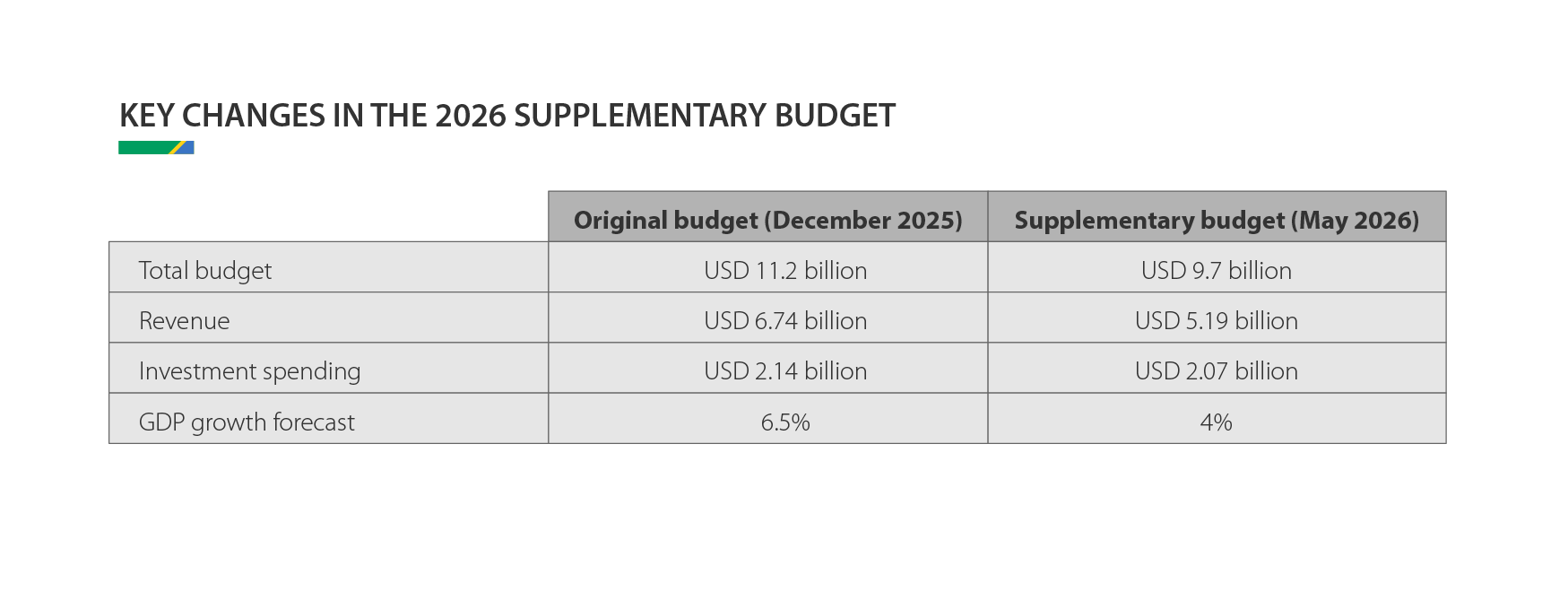
The drop in both revenue and economic growth has been attributed to weaker than anticipated production of several key goods, including timber, rubber and palm oil. This has been partly offset by a 3.1 percent improvement in oil production, complemented by an upward adjustment in the oil price on which the budget is based (now set at USD 75 rather than USD 65.20).
The drop in revenue necessitated a number of spending cuts, the most notable of which was to the investment budget. Investment spending totals XAF 1.17 trillion (USD 2.07 billion) in the supplementary budget, compared to XAF 2.14 trillion (USD 3.79 billion) in the original budget.
Nevertheless, the supplementary budget also outlines some additional expenses that were not included in the original budget. This includes an extra XAF 43.2 billion (USD 76.48 million) for fuel subsidies and XAF 2 billion (USD 3.54 million) for flour subsidies.
Additionally, debt servicing costs have risen to XAF 487.6 billion (USD 863.23 million) in the amended budget, from XAF 419.8 billion (USD 743.20 million), with total spending on debt in the supplementary budget reaching XAF 1.31 trillion (USD 2.32 billion). No specific reason was provided for the increase in debt costs.
The supplementary budget outlines several measures intended to address the funding shortfall. To bolster revenue, tax exemptions are set to be limited and the digitalisation of tax collection improved. Rather than increasing the tax burden for the population, the budget indicates that the government intends to largely rely on the issuance of public securities to fund the budget deficit.
Why was the budget adjusted?
Finance minister Thierry Minko indicated that the adjustment was motivated by a number of factors. These include a difficult international context, efforts to improve the budgetary balance and the efficiency of public investments, and recommendations from the International Monetary Fund (IMF) and the Economic and Monetary Community of Central Africa (CEMAC).
In terms of external factors, the supplementary budget reflects a change in global economic conditions as a result of the Middle East crisis. On the positive side, the conflict has resulted in higher global oil prices, as indicated in the price change in the revised budget. Oil and gas is the country’s foremost economic sector, accounting for around 33 percent of GDP and up to 70 percent of total exports.
However, the benefits of this will likely be offset by related headwinds. Firstly, although Gabon is an oil producer, limited domestic refinement capacity means that the country largely imports refined petroleum products. At present, the government has avoided any notable upswing in fuel prices through subsidy increases, as included in the revised budget, but this will weigh on state finances. The negative impacts of the Middle East crisis, including supply disruptions and elevated import costs, may also have consequences for broader GDP growth, as noted in the downward revision of the growth forecast in the new budget.
Another key consideration is the state’s already constrained fiscal position. In the original budget, expenditure had been increased by a notable 51 percent compared to the 2025 budget. This increase was not matched by a similar rise in revenue, which had resulted in an estimated fiscal deficit of around 15 percent of GDP. This higher expenditure had raised concern from domestic and external stakeholders given that it would increase reliance on borrowing and elevate an already notable debt burden. The Council of Ministers report on the supplementary budget did not disclose the new projected fiscal deficit.
The government debt-to-GDP ratio rose to around 78.9 percent in 2025, from 70.9 percent in 2024. The near-term debt burden is high with elevated short-term maturities; more than 59.5 percent of the country’s total debt is set to mature in 2026 and 2027. Given this, the budget revision may also be intended to better manage fiscal resources. Indeed, Minko indicated that the new budget represents “a recalibration towards more realistic macroeconomic assumptions”.
Improved fiscal management would align with recommendations from the IMF. Negotiations over a new programme have been ongoing since March, but the IMF is expected to require commitment to fiscal reform prior to approving a new arrangement. The supplementary budget may be an attempt to illustrate this commitment.
How will the revision impact macroeconomic fundamentals and policy direction?
The new budget is unlikely to see notable macroeconomic or fiscal improvement. More limited investment spending will have negative ramifications for GDP growth prospects. Given this, and other near-term headwinds associated with the Middle East crisis such as elevated inflationary pressures, it is likely that economic growth will be lower than the government’s current 4 percent forecast.
In recent years, GDP growth has remained relatively subdued despite forecast improvements, with the growth rate estimated to have measured 2.5 percent in 2025, down from 3.4 percent in 2024. Current global economic conditions indicate that the forecast improvement for 2026 is similarly unlikely. To this end, external growth forecasts have been lower than those provided by the government. The IMF forecasts GDP growth of 2.7 percent for 2026, while Fitch Ratings predicts slightly higher growth of 3.2 percent.
Similarly, the spending reduction is unlikely to notably improve fiscal balances. The reduction was still accompanied by lower revenue forecasts. The changes in the supplementary budget may allow the fiscal deficit to narrow slightly, but it is likely to remain high. The IMF forecast in April that the deficit would reach around 9.97 percent of GDP in 2026. Elevated recourse to regional markets to fund the shortfall in the supplementary budget will also weigh on debt metrics, with the government debt-to-GDP ratio forecast to rise to around 86.1 percent in 2026.
A notable debt burden will continue to underscore low credit ratings, as evidenced in Fitch’s affirmation on 22 May of Gabon’s long-term foreign-currency issuer default rating (IDR) at ‘CCC-‘ and long-term local-currency IDR at ‘CC’. Fitch had downgraded the country’s ratings in its previous review in December 2025. Fitch indicated that the ratings decision was based on a number of downside factors, including significant refinancing needs, limited sources of financing, reliance on hydrocarbons revenue, rising debt, and persistent public financial management deficiencies. Debt concerns and poor credit ratings will lead to continued caution from investors, particularly in non-oil sectors.
Looking forward, the budget revision does highlight a shift to a more austerity-based policy direction, though with the maintenance of some provisions to limit cost-of-living concerns. The state is expected to continue to balance popular grievances with fiscal reform recommendations from the IMF.
What are the implications for ongoing discussions with the IMF over a new arrangement?
While the reduction in spending should support the government’s efforts to secure an IMF programme, a new arrangement is still unlikely to be finalised in 2026. As noted, the supplementary budget was likely an attempt by the state to illustrate a commitment to reform as per recommendations made by the IMF. The reduction in spending should be welcomed by the IMF and will likely be viewed as a step in the right direction towards the approval of a new programme. Nevertheless, the IMF is likely to require several further adjustments prior to any official agreement over a new arrangement.
A key sticking point over the near term could be government subsidies (particularly given that these were elevated in the supplementary budget). Pressure from the IMF could push the government to implement further austerity measures, including a reduction in state subsidies and measures to improve tax management, but the complete removal of subsidies is unlikely given the state’s efforts to minimise discontent from the population.
Another barrier to the attainment of a new programme is likely to be debt management and, particularly, the clearance of arrears. In the latest Fitch review, the credit agency noted that Gabon had accumulated arrears to an amount of around 4.8 percent of GDP in 2025. Data on current arrears is limited, but the state has previously been behind on payments to a number of creditors and suppliers including the World Bank, Turkish energy firm Karpowership, and several domestic banks.
A sustained improvement in debt management and more prolonged engagement with the IMF are likely to be necessary before an agreement on a new programme is reached. The likely delay to the conclusion of an agreement with the IMF was highlighted in the latest Fitch review, where the credit agency suggested that it did not anticipate any new programme until late 2027.
Will spending cuts elevate the risk of anti-government mobilisation in the near term?
Protests are unlikely in the immediate term given that the spending cuts largely impacted longer-term projects rather than social initiatives that would have a more notable impact on the population. However, the potential for demonstrations will rise over the coming months. Protest action could be catalysed by any future reduction in subsidies, tax changes, or cuts to social initiatives implemented during ongoing negotiations with the IMF.
Overall, disenchantment towards the government appears to be on the rise and will likely continue to increase given limited improvement to economic growth and continued cost-of-living concerns (driven by high poverty levels and low average incomes, despite low inflation). This was recently highlighted in a series of strikes in the public health and education sectors in January.
Regardless, no widespread or destabilising protest movement is anticipated at this stage. Protests that do take place will likely remain small-scale and localised, with disruptive unrest limited. The potential for broader mobilisation will continue to be limited by a weak and disorganised political opposition as well as the state’s control over the security environment. This has been enabled by president Brice Clotaire Oligui Nguema‘s strong links to the armed forces as an ex-army general and the integration of the military in the ruling administration. Youth-led protest action will also be curtailed by continued restrictions on social media use, following the suspension of several social media platforms in February.